Monday, May 31, 2010

Alvin Barton Barber: From Oregon to San Francisco to Phillipines to Poland to Washington


Captain Alvin B. Barber, ca. 1912

I admit that I was more interested by the women in my family when I started these explorations, but the men are emerging as their own personalities as I move deeper into this project. My father and I were just discussing his grandfather Alvin Barton Barber known as Vin to most of his family and almost always Capt. A. B. Barber in print. Dad thought Vin and his accomplishments were a bit overwhelmed by his wife's Lucy Barber's intelligence and ambition.  So I thought I'd tried to track down his movements for  a while and in that way get a little clearer on how he played a force in the family's life.

He was born in Portland, Oregon in May 1883.

I don't yet know much about his schooling there, but he was off to West Point in 1901.  This little clip from a biography of West Point Grads shows what he did from then until 1909:

Play

We know from Fanny Barber's diary that he spent the summer of 1905 in Portland with his family and going on excursion with Lucy Lombardi (see other posting on that summer).

From family legend, we know he helped with the aftermath of the SF Earthquake of 1906 but before that he was at Rodeo Valley for the Departments Rifle Range until February 12, 1906. I think Rodeo is a small town between Richmond and Vallejo, California. He then transferred to Fort Mason in
San Francisco.  Soldiers there were the first to be called up to service in the April earthquake.

That summer he ranked as 7th in the whole Pacific Region in his rifle accuracy and you can see he is sent off to various rife competitions in Monterey and Illinois.


In August 1907, he is sent to the Philippines where he is assistant to the Office of the Chief Engineer. In the big sense, he was needed in the Phillipines since the US was trying to establish firm territorial control over the place after the "Spanish-American" War of 1899 turned into the "Filipino insurrection" that lasted officially through 1902 and unofficially through most of the decade. William Howard Taft was in charge of the Territory through 1900 and left in 1904 to serve as Roosevelt's Vice President.  Other Civil Governors of the Territory continued to rely on the army to help many Islands develop.  By 1907, the US had declared the Island peaceful and had helped the loyal Filipinos establish a legislature; and missionaries and officer wives were busy helping everyone learn modern values:


He would have been there for the visit of Taft on October 15, 1907 to inspect the island. But otherwise, I have not found out much about what he did while there. 

In June 1908, he and Lucy Lombardi are engaged and by August 1908 they are married. (Source San Francisco Call, August 30, 1908, page 30).  Lucy seemed to have accompanied him back to Philippines.  I don't know just what she did there yet, but I can't imagine she wasn't involved in some effort to help the women in Manila.  Here for example is a class of girls learning embroidery at the Paco School in Manila:

Mrs. Barber returns in February of 1909, probably because she realized she was pregnant with her first child who was born 6 months later in Berkeley.  

As I wrote above, I don't know that much about what he did in the Philippines. By 1909 March he is going to be transferred to the Washington Barracks of the Corp of Engineers and he is to serve in the Engineer school.  By April 15, 1910, he, Lucy, and son Godfrey show up living in the Washington Barracks (source 1910 Censur).  Though they are also on vacation later in that month back in Portland, Oregon staying with brother John, his wife Faith, and daughter Annie. 

His next order send him to Fort Leavenworth in August 1910.  And from there I am not entirely sure.  His next three children are all born in Berkeley, where Lucy Barber was staying with her parents.  I'm not sure if he goes off to the Mexico border or if he is doing something else.  That will be for later.  We know he heads to France for the Great War, see previous post.


Here he is a the father of 4 as a later date looking both stern and friendly:
The Barber Family, 1938??

In your memory, Captain Barber, buried in Arlington Cemetery.
 

Sunday, May 23, 2010

A Portland Oregon Summer in 1905

Portland Oregon in 1888 (thanks to LOC)

I have a diary from 1905 from my great-grandfather Alvin Barton Barber's sister Aunt Fanny Barber who went to school in Rhode Island but finished in June 1905 and returned to Portland, Oregon.  Her family lived there and she stayed with them before finding her first teaching job in Puyalip, Washington (that's how she spelled it, I know it is now Puyallup, WA).  I've been transcribing the summer entries since it makes it clear how much her brother Alvin "Vin" B. Barber and Lucy Lombardi (my great grandparents) were well known to each other by 1905 since both the families lived in Portland..  Fanny included Lucy Lombardi among the people she sent Commencement announcements, though Lucy Lombardi had finished her degree the previous year at Bryn Mawr.  Vin had finished at West Point in 1905 as well and the family returned by train to Portland, Oregon.  Vin to await his first orders in the Army and Fanny to find a job teaching school.

My transcription of this diary is not good enough yet, so instead I will share some pictures if I can find them of Portland in 1905 and the places they went for church, for "barge" parties, to the Fair, and movies they saw.

"Vin" and a Mr. West went up Mt. Rainier that summer leaving July 18, 1905 and returning "early" July 28, 1905 as did this group (they might have been in the group, the picture is from 1905):


Thanks to Oregon State University Archives, and their posting of this image on Flickr Commons, see larger version at:
http://www.flickr.com/photos/osucommons/3230006120/sizes/l/

The year 1905 was a particularly festive year in Portland since it was the year of the Lewis and Clark Exposition celebrating the centennial of the trek of them and their many fellow voyagers across the Continent. 
The Exposition celebrated the many features of Oregon, as well as a false lagoon where Fanny and family members went on July 4, 1905:
Thanks to Oregon State University Archives, and their posting of this image on Flickr Commons, see larger version

Besides exploring this area and taking a boat road on the lagoon, the Barber family also saw Trixie the Trained Horse."   The fair also included this impressive Forestry Hall which was quite a break from the "White Buildings" typical of these expositions:
Thanks to Oregon State University Archives, and their posting of this image on Flickr Commons, see here

and of course an impressive Agricultural Display:


But there were also outings to the river where she and friends would canoe or have barge parties.  Though such outings were fun, it seemed common for a wind to pick up and make the return trips quite hard.
Thanks to Oregon State University Archives, and their posting of this image on Flickr Commons

Fanny, Mrs. Lombardi and Lucy Lombardi took the train to Multanomah Falls, had lunch there (but not at the restuarant to which you might have been since it only opened in 1925) and then went to Oneonta Gorge.  Fanny writes "where I broke my glasses & got wet ‘ way up. Man rowed up back to the Falls & came back on the train."  She found the glasses when she later tried to go to Bonneville for a Salmon Festival, missed most of it, but could stop at the Falls on the way back.  This scene of a riverboat steam is about 15 years earlier, but gives the impression of where they were heading:
She also went fairly often to her "Joe" sing at Calvary Chapel.  This could have been the younger Lombardi for whom my grandfather was named. Calvary Church is still there in Portland.  Here's a rather contemporary shot of it:

Now my brother lives in Portland and sees these places 105 years later.  Bet they didn't know that would happen. 

Fanny took many naps that summer and I'm ready for one too.

Sunday, May 16, 2010

The Clean Plate Club and US Food Administration, or Take the kids to Poland, 1919-1922

Thanks to Library of Congress, link is: http://www.loc.gov/pictures/item/93502259

I wrote recently that this blog had no theme except to relate events in my family's history to larger trends.Now one could connect today's post to event in the world today, but I'll stay historical (but am grateful that I'm not seeing any cheerful posters around DC imploring me to donate to support US efforts in Afghanistan).

So today is to look at how my maternal great grandparents, Lucy Lombardi Barber and Alvin Barton Barber dealt with the "Great War."  But first some simple details.  Colonel Barber went to Britain in 1917 and stayed there, as far, as I can tell until 1922. At some point, his task became to work with the U.S. Food Administration, directed by his old friend Herbert Hoover.  In 1919, with the war over, he became more active in helping to rebuild Poland, through the American Relief Administration.  And around the same time, Lucy Barber began making plans for her and the three children, ages 10 to 4 to join him.  Col. Barber helped built the railroads in Poland as well as promote its industry.

Lucy and the children dealt with unfriendly children (see posting: http://overrepresented.blogspot.com/2010/01/barbers-and-poland-in-1920s.html  ) By the time, they returned to the States, Poland was a country again, and everyone had to get new passports.  I suspect that today, I will just include some nice images and words from elsewhere rather than report on any documents I have found about the event in Poland (which include passport applications, boat sailings, etc, and even a mention of Lillian Gish, a famous movie star of the 1910s and 1920s who kept going throughout the 20th century).

First though, a little find thanks to Google Books.  In 1920, a new magazine appeared: Poland which was described as a publication and a service; a monthly magazine for those seeking facts, figures and information regarding any phase of Polish life" and published by the American-Polish Chamber of Commerce and Liberty. 

By March 21, Col. A. B. Barber is the Vice President of this Group along with several other prominent Americans and Polish representatives:


But first, let's look at some of the efforts necessary to convince Americans to help in Europe for the Great War.  As you might remember, most Americans were not convinced that it was necessary for US to be involved in any way.  For example, the US Food Administration was designed to convince Americans to save food so that the country could export more food to the Allies.  There were posters:


Also, let us note what the US Food Administration was teaching those who read American Cookery about food manners.  In my family we grew up with the "clean plate club" and the warning to think of the "starving indians" (East Asian Indians, not native Americans). In part, this tradition was designed to keep us from eating everything in the house except vegetables.

I suspect my grandparents were taught to think of the people in England and Poland.  In any case, it was the case that I don't recall sitting down to plated meals except at dinner time with my grandparents.  Rather food was put out, perhaps soup was served, and otherwise, one made what we wanted. 
American Cookery, v. 22 - 1918, thanks to Google Books.

I love the story of the "New England Housewife" celebrating the "two whole barrelfuls of garbage" as a sign of how she had splurged (or her neighbors had splurged).  Now, people would celebrate how much they could compost!!!

Now what was a bit amazing about my great grandparents bringing the children to Poland, was that in 1917-1918, Poland's economy and infrastructure had been almost completely destroyed.  Here's an English poster on the issue:
Thanks to Library of Congress for this image.  Click and you see it in better resolution.

Here's some images from 1917:

From Ernest Bicknell, Begging Bread for Poland: Five Months of Fruitless Effort to Obtain War Relief, The Survey, vol 37 (January 6, 1917)

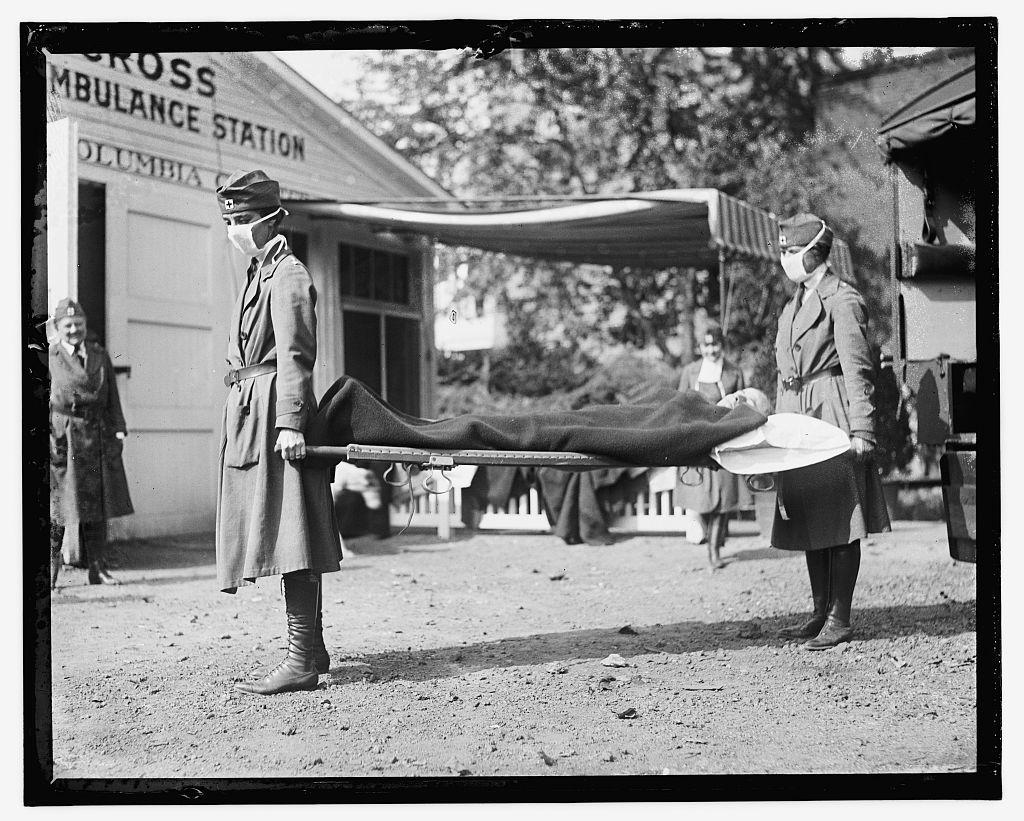
And then there was the flu epidemic that killed millions around the world (including most likely Martha Wick's father Thomas in Minnesota but C.L Barber who will marry their daughter Elizabeth is only 4 at the time). Indeed, I think the first trip to Poland for Lucy and the three children was changed because one of the children (perhaps Janet the only girl) became sick.  I think she was then left behind. In any case, in 1920, typhus broke out in Poland as Russia invaded and refugees fled the war lines.


Meanwhile, those of you who have studied history will recall that one of the main sticking points of the Treaty of Versailles was about the post-war fate of Poland, with Americans demanding a free Poland, and Germany wanting parts of Poland back.  Indeed, Germans began appealing to ethnic Germans in the Polish boundaries to assert their rights to be part of Poland by making the Polish people seem horrible:

According to the Library of Congress who supplied this poster, the text means: "This is what the Polish emigrants look like, and you'll look like this too if Silesia becomes part of Poland." Pointing to the "huddled masses at the top..  then it concludes:  "Upper Silesians! Stay with the new Germany!

Then just to make everything more chaotic, Russia started invading parts of Poland, and the country was assaulted by illness, politics, and guns again.  It was a nightmare for Wilson, and couldn't have been too great for the Barber family who returned by 1922, though the railroads were definitely in better shape, thanks to his efforts.

So I started on one upbeat note, and that was that Colonel Barber had an encounter with Lillian Gish. They both took the same boat from New York to England in 1917 (they appear as aliens on the passenger's list because the boat was English and they were Americans).  If you don't know of her, she is Famous and was for over 70 years.  She was the "it girl" of the 1910s. Appearing on stage and in movies. Here she is in 1915:

Thanks Library of Congress for another great picture, easy to find, and easy to link to: http://www.loc.gov/pictures/item/2005687253

Now the quiz questions:  Family members: did Janet get left behind?  Family Members and non Family Members, what makes Lillian Gish a bit infamous depending on your politics in different eras?

Tuesday, May 11, 2010

The Winona Normal (aka Education/Teacher's) Schools and Martha Moller Wick (a follow up)

Winona, Minnesota, circa 1898, courtesy the Library of Congress.

Since my dad said he thought Martha Wick had not started teaching until she went to Washington state (where he now lives), I wanted to confirm what I thought about when Martha Wick had finished her teaching training in Minnesota.  On June 11, 1904, the St. Paul Globe announced on June 12, that Martha Moller Wick of Jackson county had completed the Elementary Graduate Course at the Winona Normal School in the town of the same name.  I am off to find pictures of it, and of any other information about the class.  I should be back in 15 minutes on less.  Enjoy the Time-Delimited Poster in the meantime:


The pictures I have found so far of Winona Normal School are from before or after the time she was here.  Still here, thanks to the Minnesota Historical Society are two pictures.  One a photograph from the 1890s shows the strict gender divisions that defined teaching of the time:

Notice men on left of photo, women on right.  And notice the class size.  Personal, not so much.

And here is one that shows the campus becoming colorful and pretty in the 1910s (thanks to cheap synthetic color dyes making such images affordable):

Okay, my bed time has come (later I suspect that those of normal school students but still necessary.

More soon.


Sunday, May 9, 2010

Censuses, Indian Schools, and Martha Wick (later Marta Aresvik Putnam)

 Martha Wick when she was Marta Aresvik Putnam (1920s???)


[a major misspelling in title  fixed and some table display problems improved and an author's name added but I continue to work of formatting, Tuesday, May 11, 2010]

If you haven't noticed, it is 2010 and so the United States is trying to count all the citizens and residents of the United States. I'm sure David Letterman has done a 10 top ten reasons why answering the census matters. If I were to do it, it would probably have as number 8 so we could determine how make people tried to name the president with his name, misspelled it and number 1 would be taking best on how long it takes Metro (the Washington Area metro transit authority) to take the advertisements down in the buses.

But for us who like to look at the past, the Censuses are very useful to finding out who lived where and who they lived with. And even more fun can be figuring out who they lived near. In my family we tend to know the family history, but the whole point of writing is to put the family in some context. Now there is going to be some frustration in this blog. One of "challenges" of getting to the Census is that though the people can see them 70 (or 75 years) after the US collects them, "see them" for free in this case, means you have to be at a National Archives branch, or be at library that subscribes to Ancestry.Com (or pay yourself),** or dig through some resources at various Free Our Records sites rootsweb.com (closely associates with Ancestry) or FamilySearch.org.

Okay, enough about that. Let's get to some family stories gleaned from the census. In this case, it will be a census taken by the Minnesota state government and currently available at the Minnesota Historical Society for free and with a decent search interface. Many states took censuses in the middle of the decade so they could keep track of population changes, especially as immigration jumped in their state.  The least represented (in English) member of my paternal family is the adventurous Martha Moller Wick (later Marta Aresvik Putnam).  Her family came to Minnesota from Norway in [family time line needs to be consulted].  And in 1905, the state of Minnesota counted her and her family living in Jackson County, Minnesota.

Fifth Decennial Census of Minnesota Population Schedule
Fifth Decennial Census of Minnesota Population
Schedule.  Population Enumerated by me in the City
of Pipestown from 2 day June 1905 to 3 rd day June
inclusive.  J. J. Bessard.

Last

First

Loc

Sex:

Age:

Race

Place
of Birth

Place
Father Birth

Place
Mother Birth

Yrs.
in MN

Yr.
in dist.

Job

ID

Wick

Thomas

[village]

M

58

W

Norway

Norway*

Norway

18

18

Day
Laborer

5542810

Wick

Kjerstin


F

63

W

Norway

Norway

Norway

16

16

[blank]

5542544

Wick

Kristin


F

28

W

Norway

Norway

Norway

18

18

Teacher


Wick

Peter


M

26

W

Norway

Norway

Norway

18

13

Lumber
Dealer

5542746

Wick

Martha


F

21

W

Norway

Norway

Norway

18

18

Teacher

5542626 or 5542620

Wick

Dora


F

19

W

Norway

Norway

Norway

18

18

Teacher

5542242


+ Headings have been changed.
*Don’t know why it is crossed out
Census information is from Ancestry.Com  and transcribed by Lucy G. Barber

Now this little snippet tells us some interesting things. Clearly, the girls were all becoming schoolteachers.  Indeed Martha Wick was counted twice in this census since she was also counted at her school in the County of Pipestone along with her other teachers who were propbably all teachers at the Pipestone Indian School.

The Census for the town of Pipestone in Pipestone County was collected on the same days by the same enumerator as the one for Pipestone Village in Jackson County, but Mr. Bressard may not have notice the repetition or the Wick family considered Martha to be at home, even if she stayed at the School normally. Martha had only been in the district for 9.5 months.


View Minnesota Places in a larger map

The two places were not close, so I think he wrote down the wrong place and he meant County of Pipestone, or I am underestimating how far people were willing to travel. It is true that when Martha Wick marries George Rockwell Putnam in 1913, they do so in the home of her parents in Worthington, Minnesota which is in Jackson County.

 Superintendent Home for Pipestone Indian School (now used to store records!!!) National Park Service

The fact that Martha is teaching at an Indian School is fascinating to me.  During my graduate studies, I learned about these schools as agents for trying to transform the "savages" into Americans.  There have both been good histories about the schools and their cultural impact:

I hade the chance to hear Philip J. Deloria talk about this book and recommend looking for it: Playing Indian (New Haven: Yale University Press, 1998).

A more recent article looks at how women schoolteachers experienced this teaching:
D Cesar, JK Smith, THE PORTRAIT OF WOMEN TEACHERS IN INDIAN TERRITORY, American Educational History Journal 2008
Full disclosure, I have not read this article, but it is available for all of us to read.

Some searching also suggests some books on the place specifically:
Eagle, Adam Fortunate. 2010. Pipestone: my life in an Indian boarding school. Norman: University of Oklahoma Press
See full disclosure above.

And then there is the wonderful woman writer whose name completely escapes me who writes about Minnesota and Plains Indians in the present and the past. Thanks to yet another Lucy relative and reader: Louise Erdrich is the writer. Lucy S. now get a free question answered.  If you have a title you want to recommend put it in the comments.

The eleven teachers came from a variety of places, exposing Marta to women from around the country. Most were born in the United States: Iowa, Wisconsin, Indiana, North Dakota, and four from Minnesota.  One was from Nova Scotia.  I haven't checked yet, but I suspect that the women were considered federal employees and this may explain why Martha left to go teach in Washington a few years later.  All the women teachers are listed together and then the male teachers.

For the family story, one of the myths I've mentioned about Martha/Marta is that she seemed so unsophisticated next to the Putnam family, but of course if she taught in these schools and met women from so many backgrounds, she learned manners, decorum, and a lot about class.  I remember my dad saying that she also like Native American items, which this might explain. 

Of course, as often happens with these explorations I have a list of both questions and tasks now:

  • Find out if teachers were federal employees and thus look for them in guides to federal employees (and/or request Martha Wick's personnel records from National Archives
  • Learn if Minnesota county divisions changed or if this was a likely mistake or ???
  • Determine when Marta Wick finished her Normal School program at Menota, Minnesota


**Ancestry.Com is not popular with all people, including me, who are not fond of paying for access to public records, even if the people who do the volunteer work for them at many archives across the country are super nice people. See one Genealogy Newsletter for some explanation.

Sunday, May 2, 2010

Lucy introduces Ethel to Maurice (Matchmaking and the Southern Pacific)

[amended later on 5/2, edited for clarity since name repetition is confusing, and to add a factoid about biofixs photos]
I've wondered how my great-grandfather Alvin Barton Barber met Lucy Lombardi.  Both families had lived in Portland, Oregon, but both Alvin and Lucy had left by the time their engagement is announcement in The Smart Set column of the San Francisco Call in 1908.  That mystery (which may not be a mystery to some other family members)  remains a little obscure.

For a different mystery, my father sent the Cesar Maurice Lombardi letters to lots of Lombardi descendents and I heard back that my great grandmother may have been responsible for introducing a fellow Bryn Mawr student to her brother Maurice Ennis Lombardi.  Ethel Rogers Peck came from New York State

She graduated the same year as Lucy Lombardi.

Maurice went to Yale University and finished in 1900 with a Bachelor of Arts in English. He then enrolled at UC, Berkeley where he continued his father's tradition of being well-rounded and received a bachelor of science degree in 1904. He then became a Petroleum Engineer working in San Francisco, but living in Berkeley.


His father notes that he worked for a company who worked on the California oil fields of the Southern Pacific, a phenomenon described by Upton Sinclair and portrayed recently in the movie, There Will Be Blood (2007). Here's a headline from 1907 when Maurice must have hit his stride:

So when does Lucy introduce her friend Ethel to Maurice. The answer I think is in the letters by the Grandfather to the Grandchildren. The Cesar Maurice Lombardi notes he took the younger Maurice with him to Lucy's graduation in 1904 (and heard W. T. Stead speak to him to him through a medium**). So this is a likely chance, since Maurice had mostly been in California since Lucy began at Bryn Mawr.

But I will have to do some more searching to see if Ethel Peck shows up as a visitor in California. It might help if I go find out when Ethel and Maurice were married. So if someone wants to comment on that, I will go search it down. I did the research and found Mrs. Ethel Peck Lombardi listed in the
Woman's who's who of America: a biographical dictionary of contemporary women of the United States and Canada, 1914-1915 (American Commonwealth Club, 1914):
**I'll complete a research task for anyone who can tell me in a comment something interesting about W. T. Stead besides the circumstances of his death. Here's his picture, just to entice you into the challenge:


There's another interesting set of images at: http://www.encyclopedia-titanica.org/william-thomas-stead-biofix-pictures.html.  The photo fans in the readership should check them out, they are panoramics called biofixs that show a person. The link is to an article about flip-books.